Pilgrim's Rest
Pilgrim's Rest
A former prospectors' camp declared a national monument, Pilgrim's Rest preserves intact the setting of South Africa's 1870 gold rush.
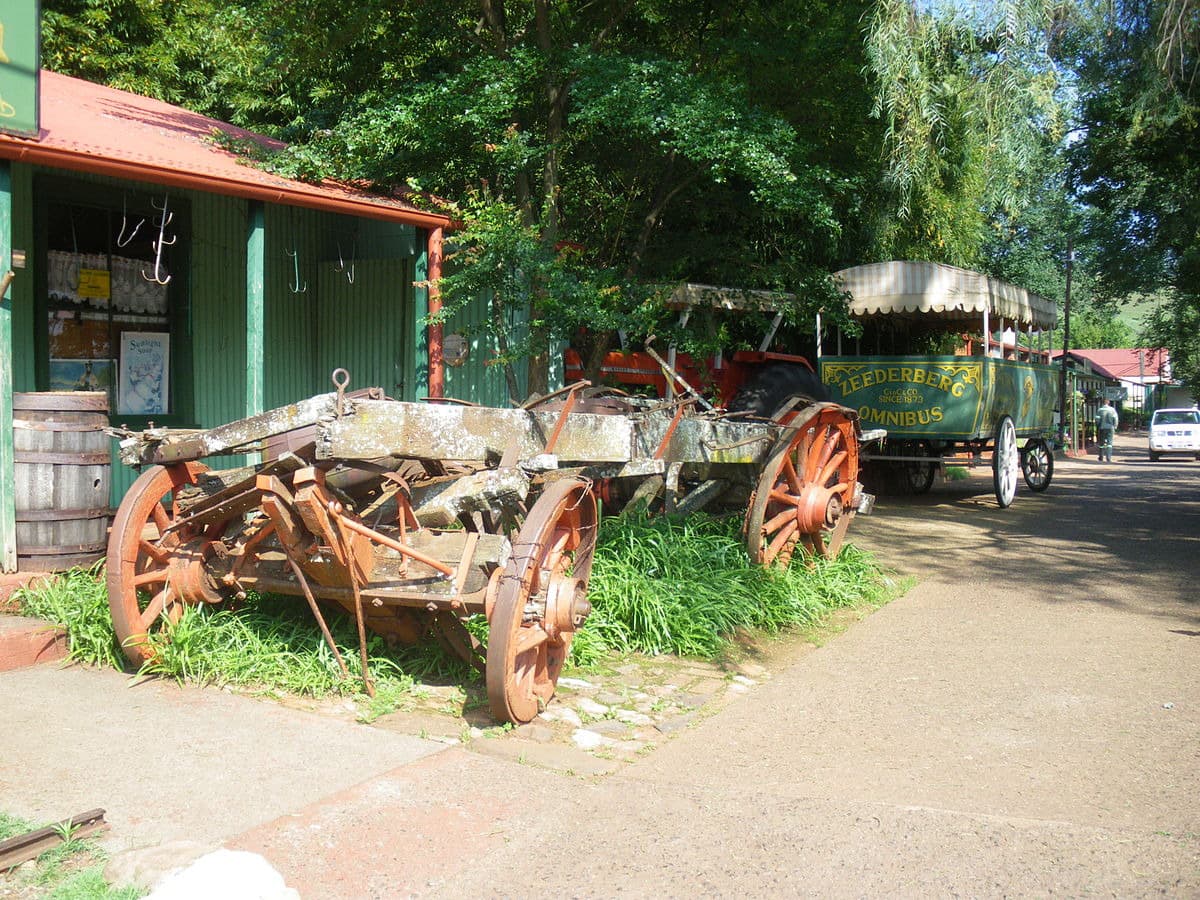
An old mining village frozen in the décor of the 1870s, Pilgrim's Rest stands today as a testament to the South African gold rush epic. Located in Mpumalanga province, near the Blyde River Canyon, this small heritage town preserves the wooden and corrugated iron architecture from its mining heyday.
Why visit Pilgrim's Rest
Pilgrim's Rest is not a reconstruction: the town was frozen by decree to preserve all of its built heritage. The scars of the gold-hunting frenzy remain visible in the surrounding landscape, and the entire urban ensemble offers a rare glimpse of life in a late 19th-century mining camp.
The stop fits naturally into an itinerary combining the Panorama Route, Blyde River Canyon and the western entrance to Kruger National Park. Allow half a day to walk through the village, longer if you extend to the cemetery and prospecting trails.
History of the gold rush
In 1873, prospector Alec "Wheelbarrow" Patterson discovers nuggets in a Transvaal stream. The news quickly attracts hundreds of seekers from across southern Africa and Europe. The 1870 gold rush transforms the region into a hub of intensive excavation, and 150 years ago, men, women and children dug in search of gold in the surrounding rivers and hills.
The ephemeral camp gradually structures itself into a permanent village, complete with bank, post office, hotels and printing press. Industrial mining replaces individual gold panning until the ore body gradually becomes depleted in the 20th century. The closure of the last mines, in 1972, could have marked the village's disappearance.
Instead, Pilgrim's Rest became a tourist attraction for the first time in 1970, with the provincial government purchasing the entire site for preservation. In 1986, the town was declared a national monument, a status that triggered a concerted effort by conservators, historians and architects to ensure the integrity of its history. The village is today a protected historical site.
What to see on-site
The historic village
The main street lines up some thirty period buildings, restored to their original state: residences, shops, the former Royal Hotel, the offices of the Pilgrim's & Sabie News and the post office. Several interiors are open to visitors.
The museum and period houses
Several buildings function as thematic museums: the open-air Diggings Site Museum, where prospecting tools and techniques are recreated, as well as the Dredzen house and the mine manager's house, furnished with period objects.
The hilltop cemetery
Perched above the village, the cemetery holds the graves of the first prospectors. The most famous, called the Robber's Grave, is oriented north-south contrary to all others: local tradition attributes this to a thief executed by the miners.
Demonstration gold panning
Panning demonstrations are offered at the site of former excavations. Gold traces remain in the subsoil, and the activity is more educational than profitable.
Practical information
- Village access: free and unrestricted for strolling the main street.
- Museums and houses: combined ticketing at the tourist office, moderate rates.
- Visit duration: 2 to 4 hours depending on sites visited.
- Food & beverage: several period establishments, including the Royal Hotel, serve meals.
- Accommodation: available on-site in the village's restored rooms or in Graskop, 15 km away.
When to visit Pilgrim's Rest
The Mpumalanga region enjoys a temperate highland climate. The dry season, April to September, offers the best visiting conditions: clear skies, mild daytime temperatures and light weekday crowds. Southern African summer (December-February) brings afternoon thunderstorms that can disrupt outdoor walking but green up the landscape. Avoid South African school holidays if you're seeking tranquility.
How to get there
Pilgrim's Rest sits some 370 km east of Johannesburg, a 4 to 5-hour drive. Access is via the R533 from Graskop (15 km) or Sabie. The road is paved and passable in a standard vehicle. The town fits naturally into a Panorama Route circuit connecting Graskop, Blyde River Canyon, God's Window and Lisbon Falls.
What to combine in the region
After Pilgrim's Rest, the Sabi Sand Game Reserve makes for a premier safari stop, adjoining Kruger National Park. To continue south, Table Mountain, Cape Point and Cape of Good Hope rank among the major sites of the Cape Peninsula.
Frequently asked questions
Frequently asked questions
Allow 2 to 4 hours to walk the main street, visit the principal museums and climb to the cemetery. A full day is possible if you combine a gold-panning demonstration and lunch on-site.
Yes. The pedestrian village format, living museums and demonstration gold panning particularly interest children. Distances are short and terraces allow you to break up your visit.
The subsoil still contains gold traces, but mining rights are protected. Panning demonstrations let you experience the technique without commercial intent.
Both options make sense. Staying on-site lets you enjoy the village once day-trippers depart. Graskop, 15 km away, offers more accommodation and dining choices and serves as a good base for the Panorama Route.
Planning your trip
Pilgrim's Rest fits perfectly into a circuit combining the Panorama Route and Kruger National Park. To build a custom itinerary including this heritage stop, explore our South Africa travel suggestions.
Interested in this visit?
We can include it in your personalised itinerary.