What is the Sardine Run, the world's largest fish migration
Did you know there's a natural phenomenon rivaling the Great Migration of wildebeest in East Africa? It's the Sardine Run,
Did you know there's a natural phenomenon rivaling the Great Migration of wildebeest in East Africa? It's the Sardine Run, a seasonal movement of billions of sardines that migrate each year along the coast of South Africa. Attracting numerous predators (dolphins, sharks, whales...), this migration offers a unique experience for travelers, whether diving, boating, or even from the shore... We tell you more.
One of the world's greatest animal migrations
The Sardine Run is a seasonal movement of sardines that takes place every year along the coast of South Africa. They are so numerous that they form schools of fish that can reach 7 km long, 1.5 km wide, and 30 m deep. According to researchers, this sardine migration could even rival, in terms of biomass, the famous Great Migration of wildebeest in Africa (in Kenya and Tanzania).
The fish in question are South African sardines, also called California pilchards (Sardinops sagax by its scientific name). Belonging to the Clupeidae family, these small fish of about 20 cm long are characterized by an elongated cylindrical body with silvery hues, blue-green reflections on the back, and white flanks. They are pelagic fish, meaning they live in the open sea.
Billions of sardines originate from South Africa's temperate and cool Atlantic coast and head toward the temporary upwelling of cold water off the south-eastern coast. They move along the Eastern Cape coast and up to the southern coast of KwaZulu-Natal, in the Durban region, to follow cooler currents. Indeed, this fish species prefers cool temperatures: between 16 and 23°C in summer and 10 to 18°C in winter.
Threats facing the sardines:
Unfortunately, sardines face several threats that could undermine the extraordinary Sardine Run phenomenon, including:
Climate change, which could force them to shift their distribution range,
Overfishing: sardines are among the most heavily fished species by humans,
Exploitation of natural gas deposits,
South Africa's very rapid economic development.
An event that attracts many predators...

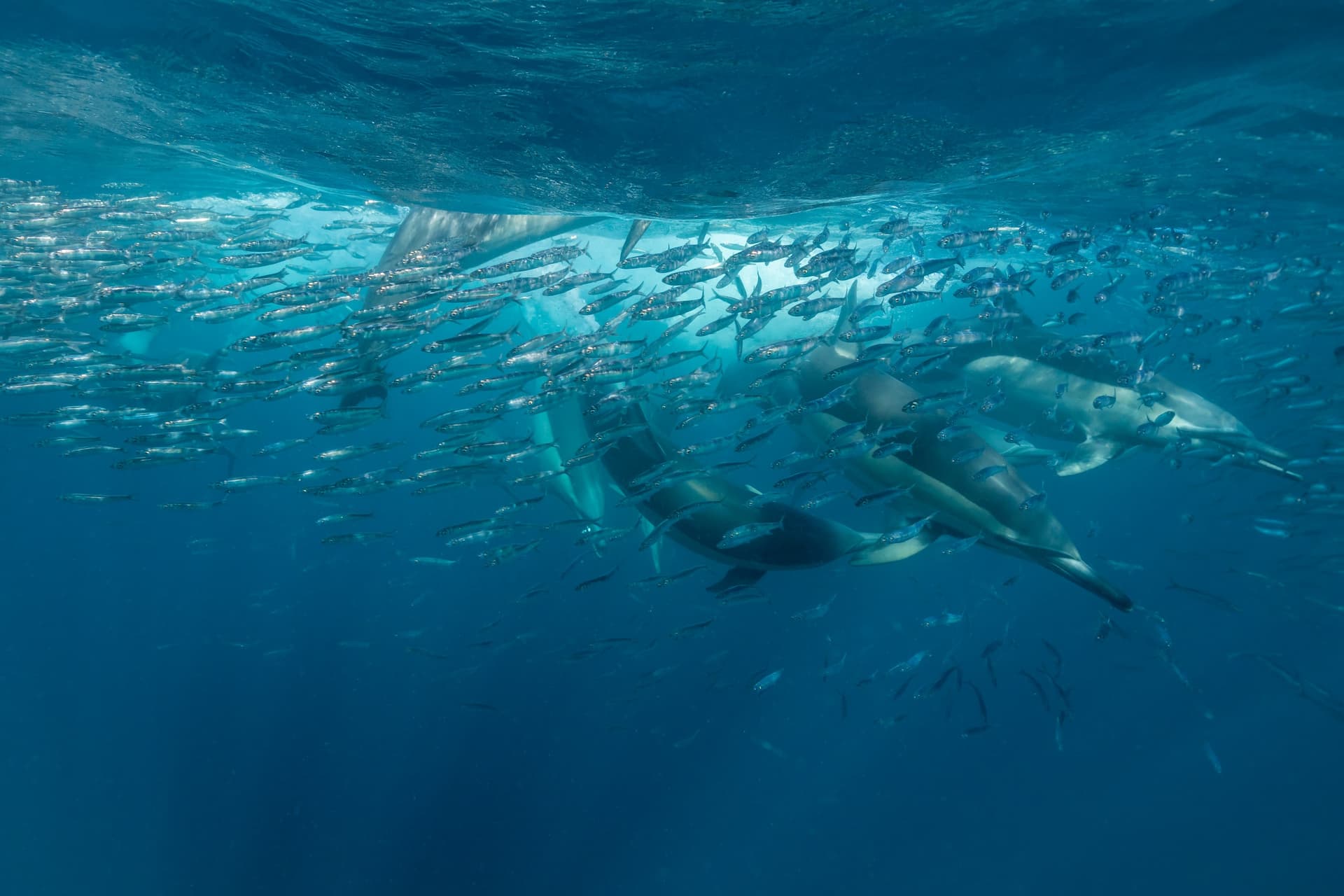
Of course, this natural phenomenon does not go unnoticed by predators. The number of sardines is so impressive that it triggers a feeding frenzy.
Among the predators that can be seen during the Sardine Run are:
Dolphins: Common dolphin, Bottlenose dolphin... ;
Sharks: Bull shark, Blacktip shark, Tiger shark, Sombre shark, Copper shark, Grey nurse shark, Blacktip reef shark, Slender shark, Zambezi shark... ;
Whales: Minke whale, Bryde's whale, Humpback whale...
Orcas (or killer whales) ;
Cape fur seals ;
Large fish: Tuna, Mackerel...
Birds: Gannet, Gulls, African penguin...
It is generally the dolphins that initiate the hunt by diving to the bottom to force the sardine schools upward, transforming them into balls called "Baitballs". As they rise to the surface, the sardines attract seabirds that put on a striking display with plunging dives reaching depths of up to 12 m.
Next come the other predators such as sharks that thrash about and fight each other, whales that emerge from the depths with gaping mouths to swallow as many as possible, and large fish that try to take advantage of the feast. The fishermen arrive last with their large nets.
Note:
While humpback whales are often part of the action, it's not because they're attracted to the sardines. In fact, they accompany them in their race because they use the same currents to move northward to their breeding areas and calving zones. Discover our article: where to see humpback whales in South Africa?
A phenomenon still poorly understood by scientists
While the Sardine Run is referred to as a migration, the reality is different since the sardines that participate represent only 2% of the Cape population. But then, what are they doing and why embark on this dangerous journey that exposes them to almost certain death?
That's a question scientists still struggle to answer today.
According to their hypotheses, these "suicidal" schools of fish could be a means of perpetuating the species. They would brave all dangers to return to spawn in the region where they were born.
In an article from the Institute of Research for Development, Gaëlle Courcoux explains:
"Their reproductive instinct overrides their survival instinct and drives them to overcome all obstacles to return and spawn in the region where they were born. The logic is relentless: if this strategy, called Homing, worked for them, it will also succeed for their offspring. Ultimately, the population assessment proves them right: the great reproductive success outweighs the high mortality during migration".
This behavior could also be a relic inherited from the last ice age, when the subtropical Indian Ocean was an important cold-water nursery area for sardines. As a reminder, sardines prefer cold waters. According to researchers, the water needs to drop below 21°C for the sardine migration to occur.
How to see the Sardine Run in South Africa?
The Sardine Run offers an extraordinary and unique natural spectacle in the world. So, if you're traveling in South Africa at the same time, we strongly recommend seeing it up close! Here are the different ways to see the Sardine Run in South Africa:
The Sardine Run from the shore
The sardine schools are so large that they can be seen from the shore. You'll notably see immense silvery waves moving and the ballet of birds diving into the water head-first. Other signs suggest that sardines are in the area: shark and dolphin fins, the presence of whales, and masses of seabirds circling above the scene.
Boat excursion to see the Sardine Run
To see the phenomenon up close, you can consider a boat excursion. It's ideal if you want to witness the Sardine Run safely without having to dive. If you'd like, you can opt for an excursion combining boat and snorkeling so you can jump in and see the spectacle beneath your feet.
Seeing the Sardine Run through scuba diving, snorkeling or freediving

Diving during the Sardine Run offers a rare and unforgettable experience. With scuba diving, you'll be invited to dive to depths ranging from 10 to 30 m to observe the schools of fish from below. If you're not comfortable, you can prefer a snorkeling outing to enjoy the spectacle from above. And for an immersive experience, freediving remains the best option!
To remember:
Dives during the Sardine Run can sometimes be impressive and challenging: boat entries into the water are sometimes difficult due to large waves. Not to mention the presence of predators, which can be intimidating. This is why we recommend this activity for experienced divers. Discover everything you need to know before diving during the Sardine Run at the end of the article.
The Sardine Run from the air
Last option to discover the Sardine Run in South Africa: treat yourself to a flight in a microlight, helicopter, or airplane to see the phenomenon from above. An opportunity to gain perspective and admire an ocean spectacle that will mark your mind forever.
Where to go in South Africa to see the Sardine Run?

The sardines migrate from the Agulhas Bank off the Western Cape and move along the coast of KwaZulu-Natal province to Mozambique. The best spots to see the Sardine Run are therefore located along the coast. But since the fish move northward, the spots change from day to day.
Among the best spots to see the Sardine Run:
Port Elizabeth,
Port Alfred,
East London,
Cintsa,
Wave Crest (the best spot for observing the Sardine Run from the shore),
Coffee Bay,
Mdumbi
Port St. Johns,
Mboyti,
Aliwal Shoal (excellent diving spot),
Durban beaches.
When does the Sardine Run take place in South Africa?
The Sardine Run takes place each year between the months of May and August. As the fish move northward along the country's east coast, you must choose your destination based on the start date of the migration. Generally speaking, the Sardine Run begins in May around Port Elizabeth and East London and continues in June and July toward Coffee Bay, Port St. Johns, and Mboyti.
To increase your chances of seeing the gigantic schools of sardines, it's generally recommended to plan a trip during June and July. These are the times when the schools are most impressive and predators most numerous.
Good to know:
Keep in mind that the Sardine Run is a natural phenomenon and it's impossible to predict exact dates since a number of factors can influence the start and end dates of this unusual migration. It's therefore better to plan flexible travel dates.
What you need to know before seeing the Sardine Run in South Africa
The Sardine Run promises an experience rich in emotion for all nature and adventure lovers. But you still need to prepare properly. Here's a list of things to know before you go:
Water temperatures are cool
Whether you plan to dive or snorkel, expect to feel cold. Average water temperatures are between 13 and 21°C. This is why you should plan or rent a thick or drysuit, as well as appropriate equipment (gloves, hood...) to stay warm. Also, remember to bring warm clothing and a rain jacket for the return trip on the boat.
Dives can be challenging
As mentioned earlier, dives during the Sardine Run can be impressive. Indeed, the South African coast is subject to strong currents. Furthermore, large waves can make boat entries from shore difficult, and drift diving can prove challenging for divers without prior drift diving experience.
Moreover, visibility is not always optimal due to the commotion caused by all these animals. The presence of predators can also be intimidating and requires good self-control.
For all these reasons, dives during the Sardine Run are more suited to experienced divers (from Advanced Open Water level) and not recommended for beginners. For those who want to get in the water and don't have enough experience to feel confident, snorkeling is ideal.
Encountering the sardines is never guaranteed...
Like any natural phenomenon, it's never 100% guaranteed to see sardines during the Sardine Run. Also, for divers, you should be prepared to spend more time on the boat than in the water. While guides and operators know the area thoroughly and can easily spot the presence of sardines and predators, it can happen that you don't see them. So don't be disappointed if it happens.
The good news? South Africa's waters are teeming with marine life and are among the world's best diving destinations. You can always see other spectacular displays from Mother Nature like dolphin leaps or marvel at whales... In the end, the emotion is always there!
To go further, discover our articles on the same subject:
Frequently asked questions
The Sardine Run is a seasonal migration of billions of sardines that moves each year along the east coast of South Africa, from the Eastern Cape to KwaZulu-Natal. The schools can reach 7 km long and attract many predators such as dolphins, sharks, and whales.
The Sardine Run takes place each year between May and August. The sardines move northward: they pass around Port Elizabeth and East London in May, then reach Coffee Bay, Port St. Johns, and Mboyti in June-July. June and July are generally the most spectacular months.
The best spots for observing the Sardine Run are located along the KwaZulu-Natal coast. Wave Crest is considered the best spot from shore, while Aliwal Shoal is an excellent diving spot. Coffee Bay, Port St. Johns, and Durban are also highly sought after.
Diving during the Sardine Run is more recommended for experienced divers (Advanced Open Water level minimum) due to strong currents, drift diving, and the presence of many predators. Beginners can still enjoy the spectacle through snorkeling or from a boat.
The exact reasons remain poorly understood by scientists. The main hypothesis is that sardines return to spawn in their native region (a behavior called 'Homing'), with their reproductive instinct overriding their survival instinct. This behavior could also be a relic inherited from the last ice age.
No, like any natural phenomenon, seeing schools of sardines is never 100% guaranteed during the Sardine Run. Local guides and operators know the area well and can spot signs (birds, fins, whales), but you might not encounter the schools. It's advisable to plan flexible travel dates.