Mokala National Park
Mokala National Park
Located 75 km from Kimberley, Mokala National Park offers game drives through Northern Cape savanna, home to one of southern Africa's largest white rhino populations.
Mokala National Park lies approximately 75 km southwest of Kimberley in the Northern Cape. Managed by SANParks since 2007, this modestly-sized park — roughly 20,000 hectares — protects Karoo scrubland savanna and harbours one of southern Africa's largest white rhino populations. Its relative obscurity makes it a peaceful alternative to the country's flagship reserves.
Quick reference
- Access: R64 route from Kimberley, approximately 75 km; personal vehicle recommended.
- Entrance: paid entry, SANParks rate (residents and non-residents, differentiated pricing).
- Suggested duration: minimum one night to enjoy morning and evening game drives.
- Accommodation: SANParks camps on-site (chalets, camping) — book via SANParks.org.
- Dress code: neutral colours (khaki, beige, green) for game drives.
What you'll see
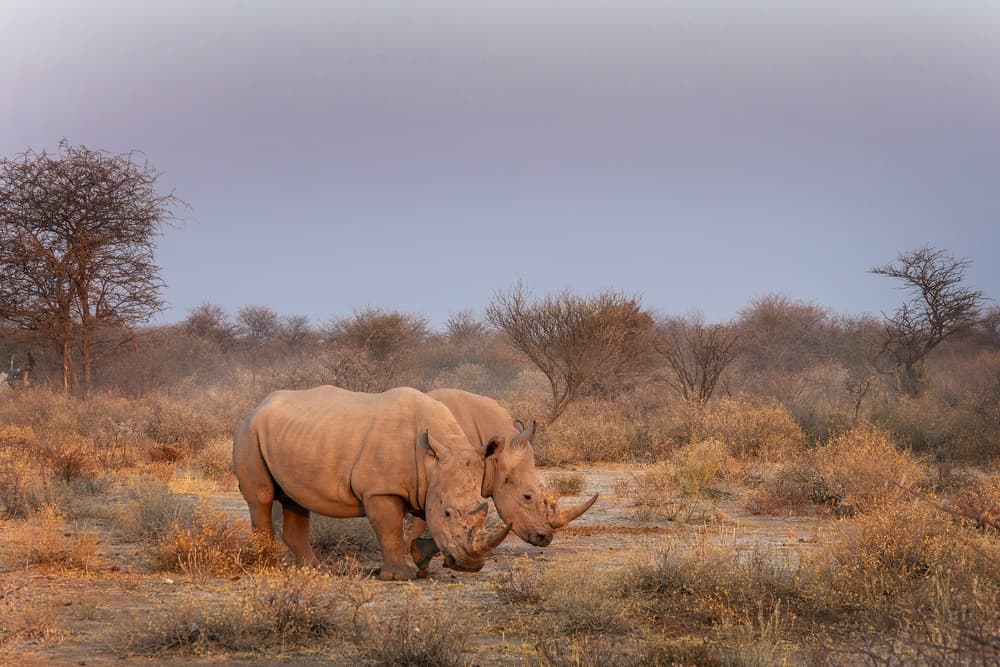
The park concentrates remarkable wildlife for its size. White rhinos are the main attraction, regularly spotted during game drives. You'll also encounter buffalo, giraffes, Burchell's zebras, blue wildebeest, kudu and several antelope species. The absence of apex predators enables guided walking activities.
Vegetation blends bushveld with Karoo elements: acacias, camelthorn, thorny shrubs. The open landscape facilitates sightings, even for first-time safari visitors.
History and context
The park was proclaimed in 2007 on land formerly used for livestock farming. SANParks reintroduced several species here, including southern white rhinos, as part of national conservation programmes. The name "Mokala" refers to the camelthorn tree (Vachellia erioloba), an emblematic species of the region.
Highlights of your visit
Game drives at sunrise and sunset
Both golden hours — early morning and late afternoon — offer the best chances of spotting rhinos and herbivore herds. Guided game drives are organized by the camp; visitors can also drive personal vehicles on marked trails.
Walking activities
The absence of large predators permits ranger-led bush walks. This is an opportunity to read tracks, identify plants and experience the savanna at ground level — a rare experience in a South African park.
Birdwatching
The park records over 200 bird species. Water sources and acacias attract raptors, rollers and weavers in particular. A species list is available at the camp reception.
Photography tips
Low-angle light at dawn and dusk is ideal for photographing rhinos in open savanna. Remain in your vehicle to avoid disturbing wildlife and use a telephoto lens. The clear Northern Cape skies minimize harsh shadows outside peak hours, though heat haze develops after 10 a.m.
Location and access
Mokala sits approximately 75 km southwest of Kimberley, reached via the R64. Kimberley has an airport with connections to Johannesburg. No public transport serves the park; a rental vehicle is essential. Internal tracks are passable in standard 2x4 vehicles during the dry season.
Nearby attractions
- Big Hole of Kimberley — the historic open-pit diamond mine, symbol of the 19th-century diamond rush.
- Kimberley Mine Museum — open-air museum recreating the Victorian mining town around the Big Hole.
Frequently asked questions
The dry season (May to September) is most favourable: vegetation is less dense, wildlife concentrates around water sources and temperatures are pleasant. Summer (November to February) is hot, and rains can make certain tracks difficult.
During the dry season, a standard vehicle suffices on main tracks. After heavy rains, some secondary tracks may require a higher-clearance vehicle.
A day allows for a morning visit to the park (dawn game drive) and reaching Kimberley in the afternoon. However, spending a night on-site is recommended to enjoy both optimal observation time slots.
No. Mokala has no apex predators, setting it apart from Big Five parks. This characteristic, however, enables guided walking activities unavailable elsewhere.
Chalets and camping sites are booked via the official SANParks website (sanparks.org). Advance booking is advised during South African school holidays.
Interested in this visit?
We can include it in your personalised itinerary.