The Cradle of Humankind
The Cradle of Humankind
An hour from Johannesburg, the Cradle of Humankind brings together 15 UNESCO-listed archaeological sites, including the famous Sterkfontein Caves.
About fifty kilometres north-west of Johannesburg, the Cradle of Humankind (Cradle of Humankind) encompasses one of the world's highest concentrations of hominid fossils. This landscape of limestone hills, inscribed as a UNESCO World Heritage Site since 1999, is home to 15 major archaeological sites and a modern interpretation centre, Maropeng. The visit combines science, prehistory and nature walks through Gauteng.
Why visit the Cradle of Humankind
The site offers one of the rare places in the world where you can walk on terrain that has yielded fossils that have advanced knowledge of human evolution. Unlike a traditional museum, the experience combines two complementary attractions: the Maropeng reception centre, focused on education and storytelling, and the Sterkfontein Caves, an active excavation site where researchers continue to extract remains millions of years old.
For travellers on a circuit through South Africa, it's a one-day excursion accessible from Johannesburg or Pretoria, which offers a change from the country's major nature or urban attractions.
History of the site and major discoveries
The region has been studied since the 1930s. In 1936, in the Sterkfontein Caves, palaeontologist Robert Broom discovered an Australopithecus skull. But it was especially in 1947 that the site entered the history of palaeoanthropology with the discovery of "Mrs Ples", an almost complete skull of Australopithecus africanus dated to approximately 2.1 million years ago.
More recently, the patient extraction of "Little Foot", an almost complete australopithecine skeleton spotted in the 1990s and uncovered over two decades, has provided one of the most important specimens ever found. Nearby, the Rising Star cave system yielded remains of Homo naledi in 2013, a species that reignited debate over the human family tree.
These discoveries explain why the Cradle of Humankind has become a world scientific reference, on a par with East African sites in the Rift Valley.
What to see on site
The Maropeng reception centre
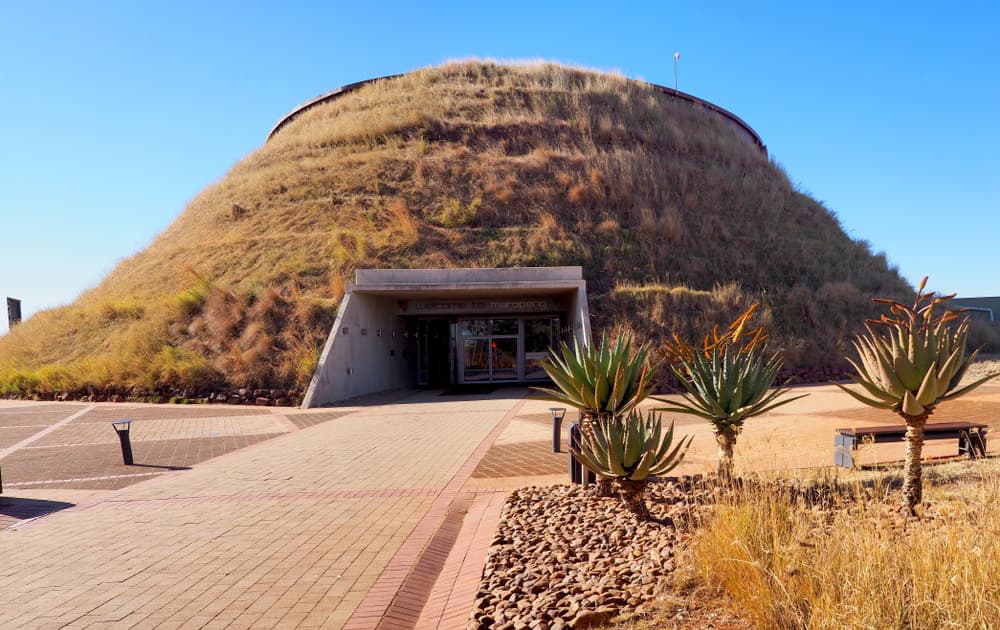
Maropeng means "return to our origins" in Setswana. The main building, shaped like a tumulus, offers a museum tour devoted to the evolution of Earth, the emergence of life and the development of the Homo genus. You will find:
- A boat tour through the elements (water, fire, air, earth) at the start of the tour
- Reconstructions of hominids and prehistoric scenes
- Original fossils and casts, including reproductions of Mrs Ples
- Educational spaces on genetics, climate and the future of humankind
Allow approximately 1.5 to 2 hours to explore the entire site. The site has a restaurant with views over the Magaliesberg.
Sterkfontein Caves
About ten kilometres from Maropeng, Sterkfontein is the most visited site. The descent is made in a group with a guide, along walkways built into an underground network where Mrs Ples and Little Foot were found. A small museum above ground presents the main discoveries and their stratigraphic context. Plan for approximately one hour for the guided cave tour.
The surrounding landscape
The classified area covers nearly 47,000 hectares of hills, grasslands and waterways. Several private reserves offer wildlife viewing (zebras, antelope), allowing you to combine a scientific visit with nature exploration.
Practical information
- Opening hours: Maropeng and Sterkfontein welcome visitors daily during the day. The last guided departures take place in mid-afternoon: it's best to arrive before lunch.
- Admission: paid entry, with a combined Maropeng + Sterkfontein ticket more advantageous than separate tickets.
- Recommended duration: a minimum of half a day, a full day if you combine both sites with lunch on site.
- What to bring: closed-toe shoes for the caves, warm clothing (low temperature underground), water.
- Contact: official website www.maropeng.co.za, telephone +27 (0)14 577 9000, email info@maropeng.co.za.
How to get there from Johannesburg
The site is approximately 1 hour's drive from central Johannesburg and 45 minutes from Pretoria. By car from Johannesburg, exit via the R400, then take the R563 towards Hekpoort. Maropeng and Sterkfontein Caves are located on the same route, about ten kilometres apart, and well signposted.
There is no direct public transport: car rental, private taxi or an organised excursion from Johannesburg are the most straightforward options. Several agencies offer half-day or full-day tours combined with other sites in the region.
What to combine in the region
The Cradle of Humankind fits well into a broader South Africa itinerary. Once your visit is complete, you can continue to the Cape to explore Cape Point and the Zeitz Museum of Contemporary Art Africa, or venture further into the great outdoors with the Sabi Sand Game Reserve for a safari and the Richtersveld Desert in the north-west of the country.
Frequently asked questions
Frequently asked questions
Include the Cradle of Humankind in your trip
This palaeoanthropological stop fits into any circuit beginning or ending in Johannesburg. To design an itinerary that combines UNESCO sites, wildlife and great landscapes, consult our tailor-made trips to South Africa.
Interested in this visit?
We can include it in your personalised itinerary.