Orange River
Orange River
Stretching 2,160 km, the Orange River winds through South Africa from the Drakensberg to the Atlantic. History, rafting, dams and excursions departing from Upington.
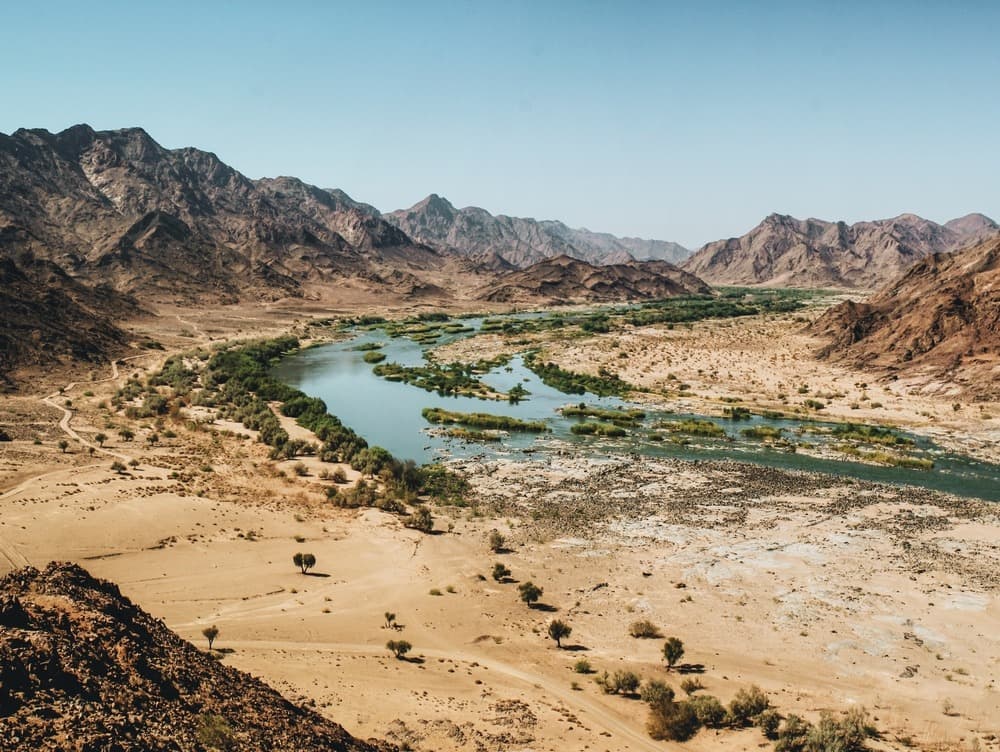
Spanning nearly 2,160 km, the Orange is South Africa's longest river. Its source lies in the Drakensberg Mountains, in Lesotho, and it flows into the Atlantic Ocean after crossing much of South African territory. Along its course, it serves as an international border between South Africa and Namibia, as well as between South Africa and Lesotho. At Upington, in the Northern Cape, it becomes a major landmark of the landscape and an essential irrigation artery for the region's crops.
Why explore the Orange
The river embodies several facets of South Africa: a leading economic role, history tied to the diamond rush, and navigable sections that make it one of the country's most renowned rafting and canoeing destinations. Its lower section, between Vioolsdrif and the Atlantic, crosses the arid landscapes of the Richtersveld, on the Namibian border. On the Lesotho side, the upper basin offers very different scenery—mountainous and cool—traversed on the back of Basotho ponies.
History and naming
Before the colonial era, the river was known as Gariep. In 1779, Jacob Gordon, commander of the Dutch East India Company's garrison at the Cape, renamed it Orange during an inland expedition. According to sources, the name refers to the ochre colour of its waters, contrasting with that of its main tributary, the Vaal, whose name means "grey". After the end of apartheid, official South African communications reintroduced the name Gariep, though Orange remains the most widely used designation internationally.
The river is also linked to a turning point in the country's economy: in 1867, the Eureka diamond is discovered near Hopetown. Two years later, the discovery of the Star of South Africa, far more substantial, triggers the diamond rush that would permanently transform the region.
What to see and do along the river
Dams and hydraulic infrastructure
The Gariep and Vanderkloof dams regulate the Orange's flow and allow irrigation of arid plains downstream, transforming them into productive agricultural zones. The Vanderkloof hydro-electric power station was the country's first power plant to operate entirely underground.
Rafting and canoeing
On the lower course, most excursions depart from Vioolsdrif, a border town on the South African side, and follow the Richtersveld. The descents alternate between paddling, swimming, fishing and camping on isolated beaches. Multi-day itineraries often conclude with a night in a waterside camp.
Aquatic wildlife
The river is home to several fish species, including Mozambique tilapia, common carp and mosquitofish. In Lesotho, high-altitude waters also welcome rainbow trout, an introduced species.
Lesotho side: Semonkong and Maletsunyane Falls
From the village of Semonkong, circuits on Basotho ponies lead to Maletsunyane Falls, among the continent's highest single-drop waterfalls. The route crosses high plateaus, mountain hamlets and gorges of the Orange's upper basin.
Best time to visit
The favourable season for canoeing and rafting runs from March to April. During this period, the opening of dam gates raises the water level and allows progress of around 30 km per day on the lower sections. The Southern Hemisphere winter months (June-August) are drier and cooler, better suited to observing wildlife along the banks than to sport descents. Summer (December-February) remains very hot in the Northern Cape, with unpredictable flow.
Practical information
- Rafting and kayaking departure points: Vioolsdrif (Northern Cape) for the Richtersveld section; Upington for shorter outings.
- Duration of descents: from half-day trips to 4 to 6-day circuits with camping.
- Level: accessible to beginners with guidance on most sections, moderate rapids.
- Equipment: sun protection essential, waterproof bag, closed-toe river shoes.
- Rates: vary by duration and operator; budget accordingly for guided multi-day circuits.
Getting there
Upington is served by a regional airport from Johannesburg and Cape Town, and is the most convenient base for reaching the middle valley. For descents to the Richtersveld, allow roughly 4 hours' drive between Upington and Vioolsdrif. On the Lesotho side, Semonkong is reached by 4x4 from Maseru, the capital, via mountain tracks.
Nearby attractions
The region offers several natural extensions to a journey along the Orange:
- The desert landscapes of the Richtersveld desert, a UNESCO World Heritage site.
- The expanses of the Northern Cape, the country's least populated province.
- The Gariep Dam nature reserve and Doornkloof park, which host Cape elk, greater kudu and black-backed jackals.
- The Mokala National Park, where you can observe Cape buffalo, warthogs, zebras, giraffes and several antelope species.
- To extend to the coastal side, the Cape Peninsula remains a classic leg of a South African itinerary.
Frequently asked questions
Frequently asked questions
The Orange measures approximately 2,160 km, making it South Africa's longest river. It originates in the Drakensberg Mountains in Lesotho and flows into the Atlantic Ocean.
Yes. The Orange marks part of the border between South Africa and Namibia, as well as between South Africa and Lesotho.
The most favourable period is between March and April. Water levels are then higher thanks to summer rainfall and the opening of dam gates, allowing progress of roughly 30 km per day.
Lower-course descents generally start from Vioolsdrif, a border town in the Northern Cape, and follow the Richtersveld landscapes. Upington remains a convenient logistics base.
The name was given in 1779 by Jacob Gordon, commander of the Dutch East India Company's garrison at the Cape. The origin refers to the ochre colour of its waters. The historical name Gariep remains used in official South African communications.
Plan your trip
To incorporate the Orange River into a custom itinerary combining the Northern Cape, Richtersveld and national parks, consult our South Africa journeys.
Interested in this visit?
We can include it in your personalised itinerary.